
The Power Of Testimonial Witnessing
How to Use This Lesson
This lesson is designed to be completed alongside the teaching video, but you may choose how you engage with it. It is self-paced—you can pause to reflect or take notes at anytime. Here are the three ways to participate in this lesson:
You can:
- Watch and read. Follow along with the video walkthrough as the instructor highlights and explains the curriculum, then scroll back through the written lesson to review or take notes.
- Read first, then watch. Read the lesson at your own pace, then watch the video for clarification, emphasis, and practical application.
- Pause and reflect as prompted. At certain points, you will be invited to pause the video for up to five minutes to reflect or write brief responses. These pauses are intentional and especially useful in group settings.
- Don’t forget to look for homework or additional resources that may be available at the end of sections, reflection exercise, or lesson.
Let’s Begin!
God’s Greatest Tool To Reach Others Is You!
God’s primary means of reaching people has never been programs, platforms, or personalities—it has always been ordinary believers living authentic lives in everyday relationships. Scripture and experience both testify to the same truth: God delights in using real people with real stories to point others to Christ.
Studies consistently show that 70-80% of people who come to faith in Jesus do so through the influence of a friend, family member, or trusted relationship. This is not accidental. God has intentionally placed every believer within a designed circle of influence—family, friends, neighbors, coworkers, classmates, and community connections. Missionaries and evangelist call this “Concentric Circles Of Concern”.
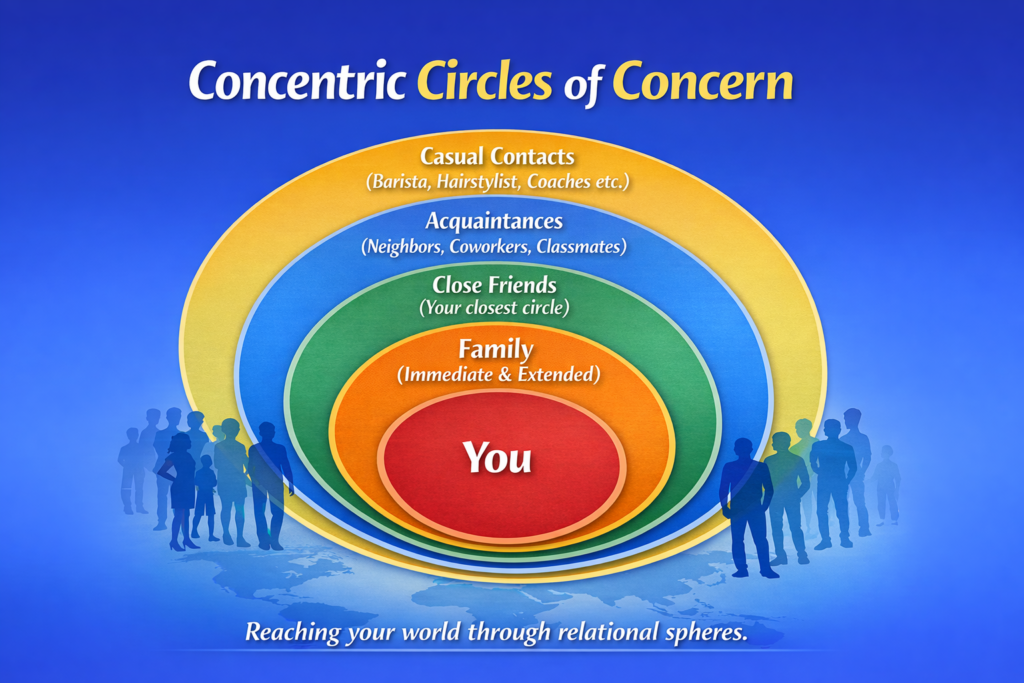
None of the relationships in in your life are random. They represent the mission field God has already assigned to you. Just as God providentially calls missionaries to a certain pinpoint part of the world He has placed you exactly where you exert natural influence.
Let’s look at Romans 10:14-15:
How then will they call on him in whom they have not believed? And how are they to believe in him of whom they have never heard? And how are they to hear without someone preaching? And how are they to preach unless they are sent? As it is written, “How beautiful are the feet of those who preach the good news!”
Romans 10:14-15
This is God’s game plan for reaching the lost. He providentially places each one of us in our own corner of His vineyard—our unique mission field—and calls us to bear witness within the context of real interpersonal relationships: beginning with family, then extending to relatives, close friends, associates, neighbors, and even our everyday connections in the community with people like shopkeepers, barbers, and others we regularly encounter. None of these relationships is accidental. Though they may appear random, they are not.
There are no accidental meetings in the providence of God
John MacArthur
One of the first things anyone who desires to be effective in personal evangelism—testimonial or otherwise—must do is adopt the settled conviction that no relationship, great or small, falls outside of God’s sovereign governance over our lives. The same God who moved Paul in Acts 16:25 to remain in his prison cell after an earthquake had opened the doors in order to stay and witness to a the guard who thought he and Silas had escaped. The guard and his own family all got saved. Another instance of God orchestrating passer-by relationships was when the Spirit directed Philip in Acts 8 to a specific desert road where he would meet an Ethiopian official reading Isaiah 53.
God is actively leading us into relationships and encounters every day. He does so with the expressed purpose of placing a faithful, strategically positioned Gospel presence in the lives of people He is seeking to reach.
Every person we interact with can and should be viewed, at its core, as a divine appointment. Every individual within our concentric circles of concern is a divinely placed neighbor whom we are commanded to “love as ourselves.” This is where testimonial witnessing can become a powerful expression of that love—an act of genuine care for the very people God has strategically placed in the center of our lives. When we learn to share our story of how Jesus has transformed our brokenness with both love and courage, we become active participants in God’s redemptive plan.
Testimonial Witnessing is about intentionally investing in the relationships God has placed us in with a view to clearly and graciously sharing your own Gospel story when the opportunity presents itself.
The goal of this course is to help you recognize that God has already placed you where you are for a purpose—and that your story may be one of His most effective instruments in reaching others.
The Power Of A Personal Story
Stories have a unique ability to reach people in ways arguments rarely can. A personal story invites connection before conclusion. It opens the heart before engaging the mind.
When you share your own experience, you are not asking someone to immediately agree with your beliefs—you are simply allowing them to see how God has worked in your life. This lowers defenses and creates space for genuine conversation rather than debate.
In a cultural climate that is often skeptical of religious claims and sensitive to perceived judgment, testimony provides a respectful and relatable entry point. You are not telling someone what they should believe; you are explaining what you have encountered and how it has shaped you.
This is why personal stories are so powerful. They humanize faith. They demonstrate transformation rather than merely asserting it. And they allow the Gospel to be heard in the context of relationship.
Jesus understood this well. Rather than overwhelming people with abstract theology, He frequently taught through stories—parables drawn from everyday life that revealed deeper truths. Stories bypass resistance, engage imagination, and invite reflection.
D. L. Moody once described this approach when speaking of Christ:
“His favorite instrument of speech was the Story… He did not push the mind; he illuminated the heart… When you capture a man’s heart, his intellect comes in the next day and surrenders.”
D.L Moody was right, Jesus was on to something. Study after study has shown that narrative storytelling increases persuasive impact compared to non-narrative formats. A meta-analysis of 65 experiments involving over 13,000 participants found an overall persuasive advantage for narratives across many contexts, and research consistently indicates that stories are far more memorable than information presented outside of a story format.
Here are some New Testament examples of effective narrative story telling to create room for important theological emphasis:
| Biblical Example | Story / Narrative Approach | Result (How it prepared the ground) |
|---|---|---|
| Rich Young Ruler (Mark 10:17–22) | Jesus engages him through personal, relational dialogue about his life, obedience, and attachments rather than beginning with abstract theology. | The man’s heart and priorities are exposed before the deeper spiritual truth is revealed. |
| Good Samaritan (Luke 10:25–37) | Instead of defining “neighbor,” Jesus tells a vivid, everyday story that draws the listener in. | The lawyer must respond from conscience and imagination before receiving the teaching. |
| Woman at the Well (John 4) | Jesus begins with ordinary life (water), invites her into conversation, and gradually unfolds her story. | Relationship and narrative lower defenses, leading to revelation of Jesus and her own witness to others. |
| Paul before Agrippa (Acts 26) | Paul recounts his personal story: who he was, what happened, and how he changed. | The narrative creates emotional and intellectual engagement—Agrippa is visibly moved. |
| The Blind Man (John 9) | The healed man simply tells his lived experience: “I was blind, but now I see.” | His straightforward testimony carries persuasive power without formal argument. |
| Peter at Pentecost (Acts 2) | Peter retells Israel’s story—promises, David, and Jesus—before making his appeal. | Shared narrative frames the message, making the call to repent intelligible and compelling. |
Testimonial witnessing follows this same wisdom. Your story does not replace the Gospel message—it prepares the ground for it. When shared humbly and honestly, it creates a bridge of understanding that allows Christ to be seen not as an idea, but as a living reality. Your story is not a replacement for the Gospel, nor is it a sales pitch. It is a bridge of credibility. When shared with humility and love, your testimony creates space for others to hear not only what you believe, but why it matters.
Reflection Exercise—Pause Video
Who is in your closest circle that needs to know Jesus?
Who are the people you have already built trust with—which ones do you need to build trust with?
Whatsetting or context do you naturally influence? (home, work, school, neighborhood, social circle, etc.)
Learning Resource: The Power Of A Personal Testimony Video
Lesson One Summary
You’ve seen that God consistently uses real people and real stories to reach others. Your testimony is not a sales pitch, a debate, or a theological argument — it is a faithful account of what God has done in your life.
Homework:
1. Make out your own list of the people in each concentric circle of concern that may not know Christ—start with family, closefiriends, acquaintences, then casual contacts. (See Chart Above)
2. Watch “Confessions of a Felon” I Am Second video to see how powerful a testimony can be.
When you’re ready, continue to Lesson Two: “How to Compose Your Testimony for Sharing” where you will learn how to organize and personalize your redemption story.