
How To Become Prepared
This lesson is designed to be completed alongside the teaching video, but you may choose how you engage with it. It is self-paced—you can pause to reflect or take notes at anytime. Here are the three ways to participate in this lesson:
You can:
- Watch first, then read. Follow along with the video walkthrough as the instructor highlights and explains the curriculum, then scroll back through the written lesson to review or take notes.
- Read first, then watch. Read the lesson at your own pace, then watch the video for clarification, emphasis, and practical application.
- Pause and reflect as prompted. At certain points, you will be invited to pause the video for up to five minutes to reflect or write brief responses. These pauses are intentional and especially useful in group settings.
Let’s Begin!
Step 1—Learn How To Share Your Testimony And The Gospel
Preparation begins with clarity. Before we learn answers to objections or study different worldviews, we must first be able to explain the message we carry. The Christian is not primarily called to win arguments, but to communicate good news. If the message itself is unclear in our own mind, confidence will always feel out of reach.
Most believers struggle not because they lack faith, but because they have never organized their faith into words. Yet the Gospel is not complicated. It is a true story with a clear meaning, and your testimony is simply how that story entered your life.
Part 1 — Understanding the Gospel Message
The Gospel is the announcement of what God has done, not advice about what we must do. It answers four foundational realities every person experiences:
God — We were created for relationship with Him.
Man — We are separated from Him because of sin.
Christ — Jesus lived, died, and rose to reconcile us to God.
Response — We receive reconciliation through repentance and faith.
When these truths are understood in order, the message becomes clear and repeatable. You are not required to say everything at once; you only need to be able to explain it faithfully and simply.
Your goal is not memorization of a script but ownership of meaning.
Learning Resources: The Bridge Method, The Four Spiritual Laws, Steps To Peace With God, Apologetics Resource Library
Part 2 — Understanding Your Testimony
God’s primary means of reaching people has never been programs, platforms, or personalities—it has always been ordinary believers living authentic lives in everyday relationships. Scripture and experience both testify to the same truth: God delights in using real people with real stories to point others to Christ.Your testimony is the personal evidence of the Gospel’s reality. It shows what the message looks like in a real human life.
A helpful structure:
Before Christ — What defined your thinking, direction, or understanding of life?
Encounter — What led you to trust Christ?
After — What has changed in your understanding, purpose, or relationship with God?
Your testimony does not need to be dramatic to be powerful. The power of a testimony is not in how lost you were, but in how faithful God is.
Learning Resources: Testimonial Witnessing Online Class, Lifeway Testimonial Models, CRU Preparing Your Testimony, Apologetics Resource Library
Part 3 — Learning to Say It Naturally
Stories have a unique ability to reach people in ways arguments rarely can. A personal story invites connection before conclusion. It opens the heart before engaging the mind.
When you share your own experience, you are not asking someone to immediately agree with your beliefs—you are simply allowing them to see how God has worked in your life. This lowers defenses and creates space for genuine conversation rather than debate.
Practice describing your testimony in:
- 30 seconds (casual moment)
- 2 minutes (normal conversation)
- 5 minutes (intentional discussion)
Clarity grows through repetition. Confidence grows through familiarity. Here is a sample of an I Am Second Video.
Step 2—Know What You Believe And Why You Believe It
One of the greatest obstacles to giving a thoughtful defense of the faith is that many Christians have never worked through their own questions about Christianity. Instead, they may rely on what parents, leaders, or pastors have told them without personally examining the reasons behind those beliefs. While it is true that none of us will ever have every answer, the Christian faith does rest on real and reasonable foundations—truths we may simply not have taken the time to explore yet.
For example, a believer may be confident that the Bible is trustworthy but unable to explain why. When challenged on that point, the result can be uncertainty or silence. Moments like this can be discouraging, and embarrassment in one conversation often keeps someone from engaging in the next. Over time, that hesitation can quietly weaken a person’s willingness to speak at all.
Surveys consistently show that many Christians feel unequipped to address common questions raised by skeptics or people of other faiths, and some even carry unspoken doubts themselves. The solution is not to pretend every answer is easy, but to intentionally pursue understanding so confidence can grow alongside faith.
The good news is that you don’t have to attend seminary to discover the rational reasons and evidence behind the Christian faith—whether concerning creation, the trustworthiness of the Bible, or why God may allow suffering. Many organizations, including The Soul Project, have made it their mission to help believers first work through these questions personally and then grow confident in explaining those answers to others.
Learning Resources: ThinkCube.Info, Got Questions.Org, Evidence4Faith.org, BeThinking.org, Apologetics Resource Library
Step 3—Develop Short Term Equipping Goals
Christians can easily feel overwhelmed by the countless witnessing situations that might arise in a single day. The command to “always be ready” can seem daunting. The solution, however, is not to master responses to every religion or worldview at once, but to start with clarity—know what you believe and learn how to communicate it simply and graciously.
From there, take inventory of the people God has already placed in your life. Consider the beliefs represented within your immediate circle of influence. If your sister-in-law is agnostic and your coworker is Catholic, those may be the very areas the Lord is prompting you to understand and engage first. Rather than preparing for the entire world in theory, begin by preparing for the people God has intentionally entrusted to you.
Develop Strategies To Be Able To Share With Those Already In Your Life
God has intentionally placed every believer within a designed circle of influence—family, friends, neighbors, coworkers, classmates, and community connections. Missionaries and evangelist call this “Concentric Circles Of Concern”. This is God’s game plan for reaching the lost. He providentially places each one of us in our own corner of His vineyard—our unique mission field—and calls us to bear witness within the context of real interpersonal relationships: beginning with family, then extending to relatives, close friends, associates, neighbors, and even our everyday connections in the community with people like shopkeepers, barbers, and others we regularly encounter.
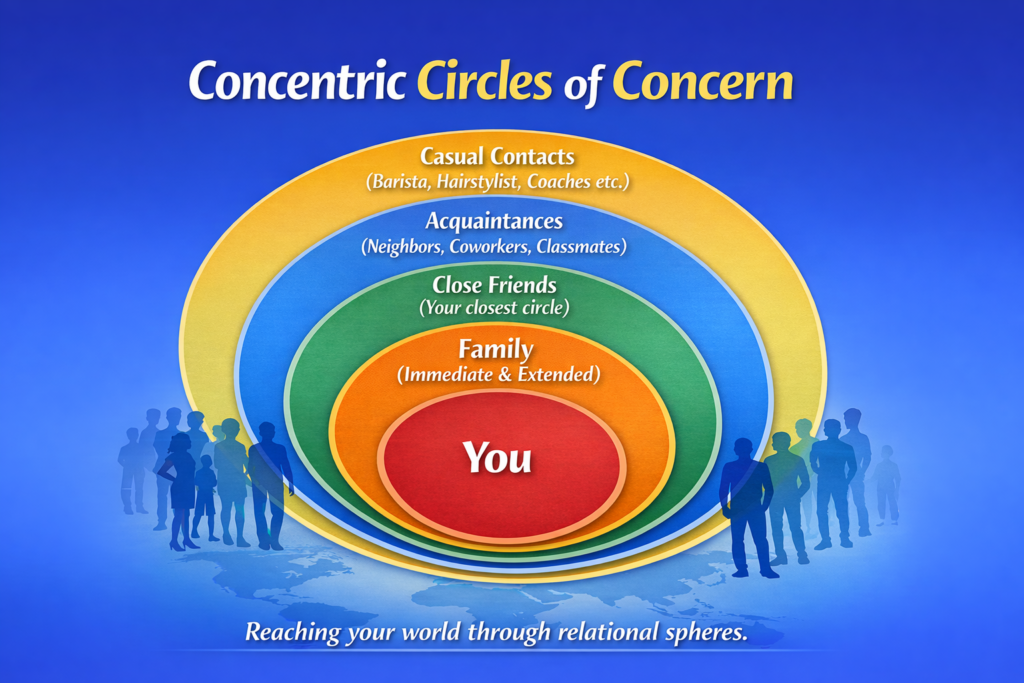
Keys for short term equipping goals:
- Identify your context.
Take inventory of the witnessing situations and opposing worldviews represented within your first three circles of influence. - Focus your preparation.
Select one worldview and devote the next 30 days to learning about it—read articles, take training, and watch videos that explain its background, terminology, and practical ways to engage respectfully and clearly. - Use helpful tools immediately.
While you are learning, make use of shareable resources such as ThinkCube.info and QuickAnswers. These allow you to provide thoughtful, engaging responses right now, even before you feel fully equipped yourself.
Learning Resources: ThinkCube.info, Apologetic Quick Share Links, Interfaith Witness Share Links,
Step 5—Develop Long Term Equipping Goals
After you determine your learning priorities, you can extend your plan into the future. Many mission training centers and seminaries use a concentration approach: rather than spreading attention across every area of apologetics or evangelism, they organize focused learning blocks.
In this approach you choose one worldview—such as Islam—and remain intentionally focused on it for a season. During that time you seek out reliable tools, courses, and materials, working toward a working understanding of its historical background, terminology, traditions, and core beliefs.
Numerous organizations are devoted to equipping believers in these specialized areas. To save you time, we have gathered many of these ministries, training resources, and learning pathways in the Apologetics Resource Library, where you can continue building a clear and structured equipping plan.
Step 6—Commit To Continued Learning And Progress
Preparation for witness is not a one-time project but a lifelong pattern. Confidence grows over time as knowledge, experience, and dependence on God develop together. Rather than trying to learn everything at once, commit to steady, focused progress. Small, consistent investment produces far greater readiness than occasional bursts of study.
Begin by establishing a simple rhythm. Set aside regular time for growth—reading, watching training material, reviewing Scripture, and practicing how you would explain truth in everyday language. As you interact with people, new questions will arise. Let real conversations guide your future learning. The people God has placed around you become the roadmap for what you study next. Continue rotating through areas of concentration. After gaining familiarity with one worldview, move to another while periodically reviewing what you have already learned so it remains usable. Over time you will develop both breadth and depth, and your confidence will shift from memorized answers to clear understanding.
Most importantly, keep your growth connected to love for people, not merely information. The goal is not to win arguments but to faithfully represent Christ with clarity, gentleness, and respect. As you remain teachable and dependent on the Lord, He will steadily shape both your knowledge and your effectiveness.
Reflection Exercise—Pause Video
Is there anybody in your “Concentric Circles of Concern” that have different worldviews?
Are you willing to do whatever it takes to become “Ready To Give An Answer For Your Hope” and defend the principles of your faith with them?
Learning Exercise: Watch “How To Begin Your Apologetics Journey”
Lesson Four Summary
This lesson emphasized that readiness for witness begins with clarity, not complexity. Before learning to answer every objection, believers should first understand the Gospel, be able to share their testimony naturally, and know why they believe what they believe. From there, growth becomes practical—focusing on the people already in our lives, setting short-term learning goals, and steadily building long-term understanding. Faithful preparation is not about mastering every worldview at once, but about consistent progress as God uses us where we are.
Homework:
- 1. Develop a short-term equipping plan for a worldview you do not yet fully understand.
- Investigate these resources to see how to access and potentially use them. ThinkCube.info, Apologetic Quick Share Links, Interfaith Witness Share Links,
Thank You for Taking This Course
We hope you have enjoyed this course and found it beneficial in growing your confidence and readiness to share your faith.
All of our classes are offered freely as a ministry. If this training has been helpful to you, any donation — large or small — helps us continue developing resources and keeping them available to others at no cost.