
What It Means To CrossOver
How to Use This Lesson
This lesson is designed to be completed alongside the teaching video, but you may choose how you engage with it. It is self-paced—you can pause to reflect or take notes at anytime. Here are the three ways to participate in this lesson:
You can:
- Watch and read. Follow along with the video walkthrough as the instructor highlights and explains the curriculum, then scroll back through the written lesson to review or take notes.
- Read first, then watch. Read the lesson at your own pace, then watch the video for clarification, emphasis, and practical application.
- Pause and reflect as prompted. At certain points, you will be invited to pause the video for up to five minutes to reflect or write brief responses. These pauses are intentional and especially useful in group settings.
What You Will Need: 4 4×6 or 5×8 index cards
Let’s Begin!
What Is CrossOver?
CrossOver is a personal evangelism strategy plan that helps believers identify who God has placed in there spheres of influence and create a strategy for how to pray, build relationships and ultimately share the Gospel with them. Studies consistently show that 70-80% of people who come to faith in Jesus do so through the influence of a friend, family member, or trusted relationship. This is not accidental. God has intentionally placed every believer within a designed circle of influence—family, friends, neighbors, coworkers, classmates, and community connections. Missionaries and evangelist call this “Concentric Circles Of Concern”.
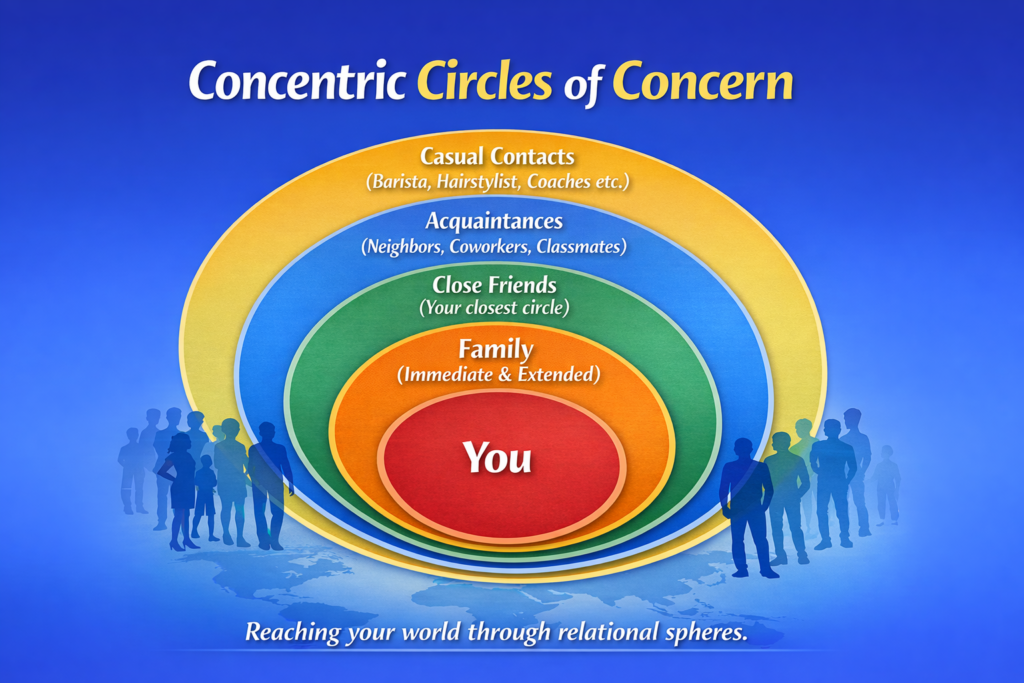
None of the relationships in in your life are random. They represent the mission field God has already assigned to you. Just as God providentially calls missionaries to a certain pinpoint part of the world He has placed you exactly where you exert natural influence.
Let’s look at Romans 10:14-15:
How then will they call on him in whom they have not believed? And how are they to believe in him of whom they have never heard? And how are they to hear without someone preaching? And how are they to preach unless they are sent? As it is written, “How beautiful are the feet of those who preach the good news!”
Romans 10:14-15
This is God’s game plan for reaching the lost. He providentially places each one of us in our own corner of His vineyard—our unique mission field—and calls us to bear witness within the context of real interpersonal relationships: beginning with family, then extending to relatives, close friends, associates, neighbors, and even our everyday connections in the community with people like shopkeepers, barbers, and others we regularly encounter. None of these relationships is accidental. Though they may appear random, they are not.
One of the first things anyone who desires to be effective in personal evangelism—testimonial or otherwise—must do is adopt the settled conviction that no relationship, great or small, falls outside of God’s sovereign governance over our lives. The same God who moved Paul in Acts 16:25 to remain in his prison cell after an earthquake had opened the doors in order to stay and witness to a the guard who thought he and Silas had escaped. The guard and his own family all got saved. Another instance of God orchestrating passer-by relationships was when the Spirit directed Philip in Acts 8 to a specific desert road where he would meet an Ethiopian official reading Isaiah 53.
God is actively leading us into relationships and encounters every day. He does so with the expressed purpose of placing a faithful, strategically positioned Gospel presence in the lives of people He is seeking to reach.
Every person we interact with can and should be viewed, at its core, as a divine appointment. Every individual within our concentric circles of concern is a divinely placed neighbor whom we are commanded to “love as ourselves.” This is where testimonial witnessing can become a powerful expression of that love—an act of genuine care for the very people God has strategically placed in the center of our lives. When we learn to share our story of how Jesus has transformed our brokenness with both love and courage, we become active participants in God’s redemptive plan.
Homework: Download this PDF and print two copies for next section.
Section 2 : Steps To Take Before You CrossOver
The goal of this course is to help you identify who God Himself has strategically placed in your life and come along side Him in thinking about, planning, and praying for how you can reach them with the Gospel. Here are the steps to developing your own CrossOver Missionary Strategy:
Step 1— Make a list of everyone in your circles of concentric concern
God has already placed people in your life. Your first assignment is not to find new people — it is to prayerfully identify the ones already entrusted to you. Using the Concentric Circles model, begin writing down actual names in each category:
Family (Immediate & Extended)
List parents, siblings, children, cousins, in-laws — anyone related to you by blood or marriage.
Close Friends
Those who know you well. People you trust and spend consistent time with.
Acquaintances
Neighbors, coworkers, classmates, gym partners, teammates — people you see regularly but may not know deeply.
Casual Contacts
Barista, hairstylist, mail carrier, coaches, store clerks — individuals you interact with periodically.
Do not evaluate their spiritual condition yet.
Do not create a strategy yet.
Just write names.
Be specific. The Holy Spirit often brings people to mind as you slow down and think intentionally.
Step 2—Pray over the entire list and ask God to help you identify who might not know Him as their Lord and Savior
Starting with Family edit and create a new formal list of people you are fairly confident don’t have a relationship with Christ, or might not have a relationship with Christ. Do this for all of the “Circles Of Concern”.
Instead of trying to focus on everyone, begin by identifying the three most spiritually receptive people in each circle. One helpful way to discern spiritual openness is by prayerfully considering the following questions about each person:
- Are they hospitable and approachable?
- Do they show curiosity or openness to learning?
- Are they relational and willing to engage personally?
- Do they demonstrate any spiritual interest or hunger?
- Do they express vulnerability or concerns about life, the world, or themselves?
Step 3—Now chose the twelve or 3 from each group to prioritize on
Take one of your index cards and write “Family” at the top.
Below the heading, list three people—beginning with immediate family members—who best fit the criteria previously discussed. Space the names evenly, leaving room between them.
Next to each name, briefly note what you believe may be the greatest hindrance preventing them from hearing the Gospel or encountering God.
Then turn the card over and write “Prayer Priority” at the top.
List the same three names again, evenly spaced. Beside each name, write what you sense God leading you to specifically pray for in their life.
Be thoughtful and prayerful as you complete this exercise.
Now chose 3 from each of the other circles: close friends, acquaintances, and casual contacts and complete the same process for each of them.
Lesson One Summary
In this lesson we’ve learned about our “Concentric Circles Of Concern” and how God has strategically placed people who don’t know him in our immediate sphere of influence. Then we learned how to identify people God may be leading us to focus our prayer, hospitality, and relational intentionality toward. Please complete your 3 People From Each Circle cards before beginning next lesson.
When you are ready—Continute to Lesson Two: How To Live, Act and Speak Before the People We Hope To Reach